
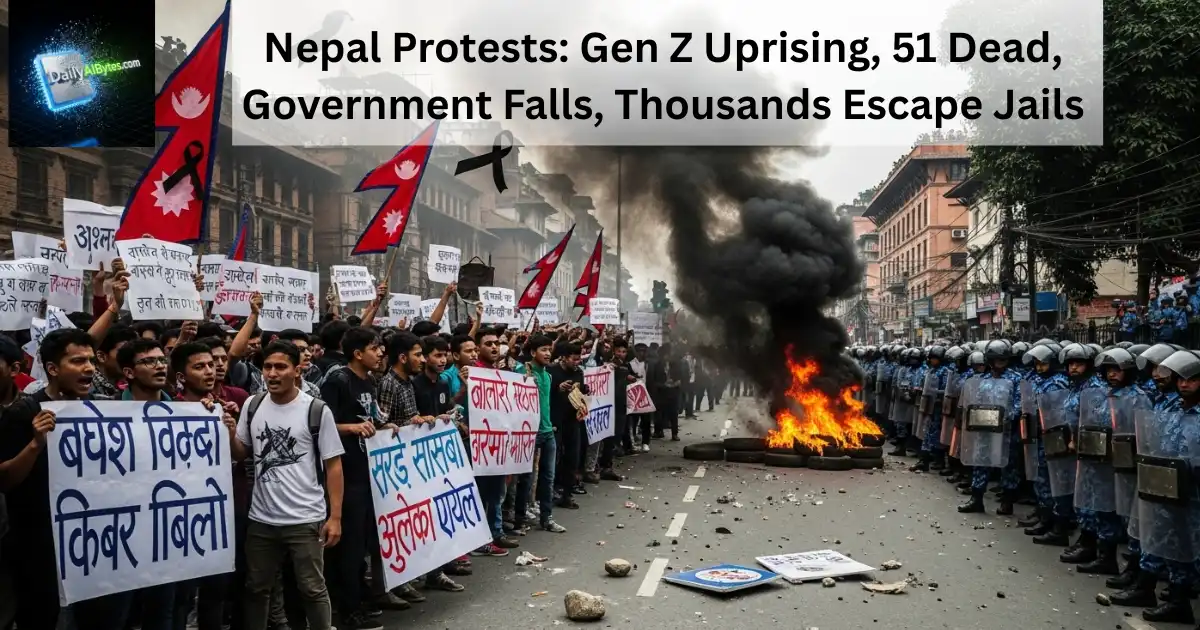
Stay updated on Nepal protests 2025: Youth-led Gen Z movement against corruption leaves 51 dead, topples government, triggers mass prison escapes, and strands foreign nationals.
Nepal is currently facing one of the biggest political and social crises in its recent history. What began as a ban on social media quickly turned into a nationwide youth-led movement against corruption, unemployment, and political apathy. The protests, largely led by Gen Z, shook the foundations of the government and forced Prime Minister K.P. Sharma Oli to resign. But the chaos has left behind deaths, destruction, and an uncertain future.
- The government banned popular social media platforms like Facebook and YouTube.
- Young Nepalis, especially Gen Z, saw this as an attack on freedom of expression.
- What started as digital outrage soon turned into massive street protests across the country.
- The demonstrations were no longer about social media; they became a symbol of frustration with corruption, poor governance, and inequality.
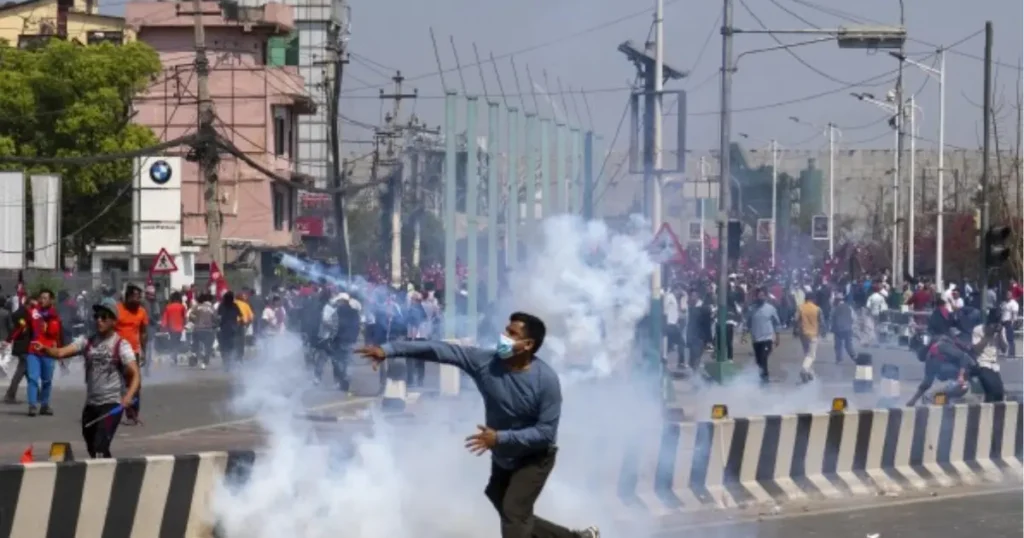
- Police have confirmed that 51 people have been killed so far.
- Among the dead are one Indian citizen and three policemen.
- Dozens of police stations, government offices, and vehicles were set on fire.
- Hundreds of people remain injured, many receiving treatment in Kathmandu hospitals.
- One of the most shocking developments came when protesters stormed jails.
- More than 12,500 prisoners escaped from prisons across Nepal.
- The Nakkhu Jail in Kathmandu saw nearly 3,000 inmates escape.
- This is the same prison where controversial leader and RSP chief Rabi Lamichhane was once held.
- The violence and protests forced Prime Minister K.P. Sharma Oli to step down.
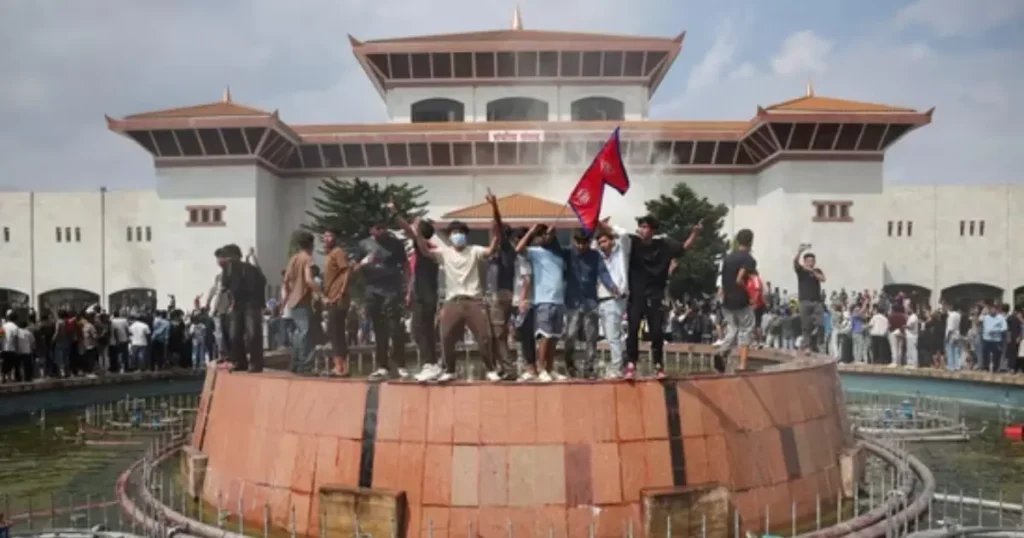
- Even Parliament was set on fire by protesters.
- Nepal is now in a political vacuum, waiting for an interim government to take charge.
- Protesters have rallied behind former Chief Justice Sushila Karki as the next interim Prime Minister.
- At 73, she is respected for her integrity and independence.
- However, political parties and the army are yet to reach a consensus.
- President Ram Chandra Poudel and the Army Chief are holding back-to-back meetings with leaders and legal experts.
- Corruption has been eating away at Nepal’s political system for years.
- Educated youth cannot find jobs and are forced to migrate abroad for low-paying work.
- Meanwhile, politicians live luxurious lives off taxpayers’ money.
- This inequality finally pushed Gen Z to take to the streets.
Struggles of Foreign Nationals
- The unrest and curfews left thousands of foreign tourists stranded in Nepal.
- Authorities have now eased visa and exit rules.
- Tourists whose visas expired after September 8 can leave without paying penalties.
- Arrangements have also been made for those who lost their passports during the chaos.
- The crisis spilled over to neighboring India as well.
- The Delhi-Kathmandu DTC bus service was stuck in Nepal.
- An Indian tourist bus returning from Pashupatinath Temple was attacked by protesters, injuring several passengers.
- The Indian Embassy arranged special flights to bring the injured and stranded back home.
- Kathmandu was supposed to host some matches of the Women’s Blind T20 World Cup in November.
- Due to the turmoil, the city has been dropped as a neutral venue.
- All games will now be shifted to India.
Attack on Judiciary
- Protesters even set fire to parts of Nepal’s Supreme Court.
- Decades of judicial records were destroyed.
- Legal associations in Nepal and abroad have condemned the attack, calling it a blow to democracy.
Rumors of Monarchy’s Return
- Civil society groups have alleged that a conspiracy is underway to restore the monarchy.
- They accuse the army of playing a bigger role in politics under the guise of maintaining order.
- Protest leaders, however, say such moves would betray the sacrifices of the Gen Z movement.
Police Return to Kathmandu Streets
- Many police stations in Kathmandu Valley were burned down.
- Security forces are now slowly returning and reopening damaged posts.
- Armed Police Force and Nepal Police are once again visible in the capital.
Hopes of the People
- The people of Nepal, especially the youth, are demanding change.
- They want a leadership that is honest and committed to development.
- Many see Sushila Karki as a ray of hope in this uncertain political environment.
Conclusion
Nepal stands at a historic crossroads. The ban on social media was just a spark — what followed was a full-blown uprising against corruption and inequality. With over 51 dead, thousands of prisoners on the run, and a toppled government, the country faces an uphill battle. The future depends on whether leaders listen to the people and embrace true democracy or allow old power structures to return.
FAQs (Frequently Asked Questions)
Q1. Why did the protests start in Nepal?
The protests began after the government banned social media platforms and expanded into a larger movement against corruption and poor governance.
Q2. How many people have died so far?
At least 51 people, including an Indian national, have been killed in the violence.
Q3. How many prisoners escaped?
More than 12,500 prisoners escaped from various jails across Nepal during the unrest.
Q4. Who is likely to become Nepal’s interim Prime Minister?
Former Chief Justice Sushila Karki has strong support from protesters, but a final decision is pending.
Q5. What measures have been taken for foreign nationals in Nepal?
The government has relaxed visa and exit rules, allowing stranded tourists to leave without extra fees.